
Industry: Elementary Education, Technology, Social-Emotional Learning
Location: Cyprus; Youngstown, OH; and Piscataway, NJ
Read the Transcript
This transcript has been AI generated. Please excuse any typos.
Elementary schools are no longer exclusively about academics. Now, educators also share responsibility for building students’ character, as well as their social and emotional health. Today, on The Angel Nest, we meet the founder of Heroes Made, a character education platform for grades one through six.
We also meet Dr. Maurice Elias of Rutgers University. He says this kind of education contributes to our kids’ mental health and is also good for society. Welcome back to The Angel Nest, where real angel investors and entrepreneurs partner to build great companies.
I’m David Hemenway. I’m a five-time founder and an active angel investor, and my mission here is to tell the stories that are powering innovation. With so much talk of a mental health crisis, even at the primary school level, founder Maria Howard decided to launch Heroes Made, a character and life skills platform that personalizes lessons to students while eliminating prep time for overburdened teachers.
It’s a pleasure to welcome Maria today, along with Dr. Maurice Elias from Rutgers University. Dr. Elias is a pioneer in social and emotional support and character-building programs for young students. Welcome to The Angel Nest, everybody.
Thanks for joining us today. Great to be here. Thank you.
Nice to be here, David. Dr. Elias, you are not affiliated with Heroes Made, but you feel like the objectives they’re seeking to accomplish here are so important that you’re helping them get the message out. That’s very compelling.
Well, their research has taught us what it is that kids need in order to be successful in school and life. They need to be able to understand their emotions, manage their emotions, work in groups, be empathic, be ethical problem solvers. No child can lack any of these things, and Maria’s work is designed to bring these things into schools in a way that I think is unique.
Well, let’s hear about that. Maria, how does Heroes Made work? Tell us. Well, thank you, David.
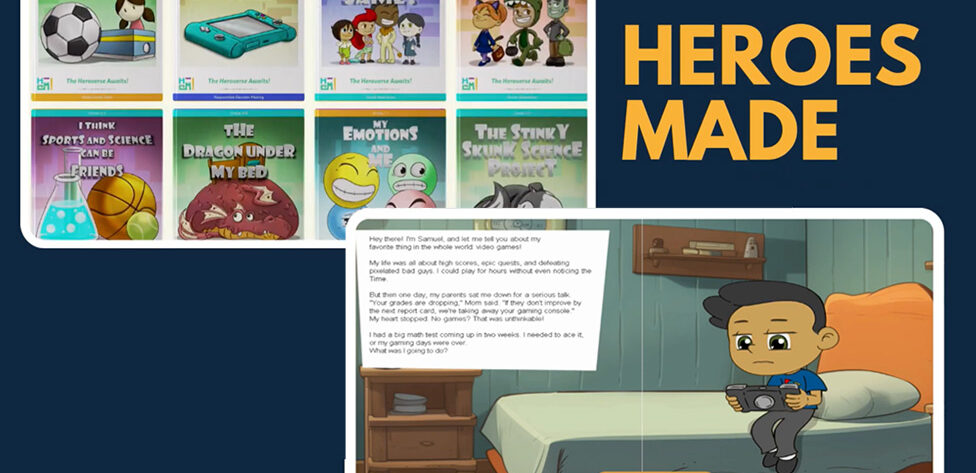
Thank you, Dr. Maurice. We took what we know works best, which is storytelling, as opposed to lectures or presentations or video. So we took storytelling and we personalized it to every student.
We prepare everything. So it’s just a click away. And kids have that excitement of owning the story because they see themselves in it.
And teachers don’t have to spend any time preparing. So there’s a lot of wonderful features around this, but that’s the summarized version of how it works. Maria, give us an example, would you, of a lesson that Heroes Made has helped teach students? OK, so we have hundreds of lessons, but one of them that comes to mind right now is my circle of control, right? And now imagine if you’re a student, you will be the hero.
Every single kid is the hero in their own learning journey, but the theme stays the same. And it’s all about self-management, understanding what is within our control and what is outside of our control and teaching them how to separate those two things to manage their emotions, their anxiety and the overall situation. I think that’s very important.
For me, I learned these things way too late in life, maybe after 30, maybe I’m still learning them. So I feel like that’s one of the things that, one of the lessons that stuck out to me quite a bit actually. And we hear a lot of good things about that as well.
Dr. Elias, this is fairly new, teaching these kinds of lessons in school, right? Weren’t these traditionally things that were learned at home? Well, yeah, I think we recognize now that life is very complicated. And we have, if you will, the old saying, it takes a village to raise a child. And so the village should be getting consistent messages about what kids need.
You know, character is not just taught, it’s also caught from the people around you. Kids spend a lot of time in school. And so it has to be a place that sends the right character messages to kids.
You know, what Heroes Made did that’s different, I think, than many other programs is they did a very thorough analysis of why good programs sit on shelves. And they built into their program, engagement, personalization, the possibility of publication, having a dashboard that gives teachers a lot of feedback about how their kids are doing. And those are things that I think will make a difference between a good program that’s on a shelf and a good program that’s in the schools.
Maria, how are teachers responding to Heroes Made? Everybody seems to just be having such a good time. Teachers, they say this is the easiest thing they used. They love the engagement.
Everybody consistently says that kids are participating more, which makes me very happy because that means that it’s working, right? And kids love the whole, it’s me and the story. Let me look at your book. Let me see this.
You know, but I want to make a small parenthesis. We’re very mindful of using technology very responsibly, right? Like we don’t want to isolate the experience on a device. So we only use it for that one part.
And then the magic happens within the classroom environment. So it happens in the physical environment. Dr. Elias, does children’s early and constant exposure to technology contribute to the mental health crisis we’re seeing? Well, I think mental health problems are a factor of so many different things.
And technology can be a help or a hindrance. Like anything else, it’s how we use it. And, you know, when television was first introduced, there was the idea that it was going to increase violence among children.
And, you know, that turned out not to be a worry. And I think here again, it’s how the technology is used. And in this case, the technology is being used to, first of all, put the kid into every story via their avatar.
And second, as an alternate to delivering text in print in your hand, you’ve got print on the screen. So it’s not really changing what the kids are experiencing. And it does enable that kind of personalization.
So I think it’s using technology for good. Yeah. Maria, it seems really fascinating that you can put children in each story, but it doesn’t add to the burden on the teacher, right? No, no, it doesn’t add any burden to the teacher.
It’s just that the first time they log in at the beginning of the year, everybody takes five minutes, they make their avatar and that’s it. It’s set for the year. We don’t, teachers have nothing to do with it.
It’s all about getting the kids involved and part of the process. Yeah. Yeah.
And I’m assuming that these lessons they’re learning is going to reduce conflict in the classroom as well. Yes, because it’s part of the process. You know, conflict resolution is, and how to build good relationships and how to have communication skills.
It’s all part of social emotional learning of character education. That’s what we aim to do. I feel, and I’m sure like you would agree with me that most of the problems we have in the world today is because we lack that ability.
We lack the ability to communicate well and to have healthy conflict resolution between us. Dr. Elias, what are the most important lessons that we should be teaching our children early on? We need to be building their skills that they need for life. It’s not that we should be teaching them specific lessons.
Life teaches them lessons. The question is, how are they going to handle it? And, you know, we teach reading for a reason. We want our kids to be better readers.
They aren’t born knowing how to read. Kids are born with social and emotional skills. But for this complex life we’re submitting them to, they’ve got to have these skills in a refined way.
And that means they have to be taught a little every year, year after year. You know, by the time the kids go through 12 years of school, they emerge into college and careers with a lot behind them. And we need them to have those skills behind them.
Maria, can you talk a little bit about how the program evolves as the children progress through the grades since you’re covering grades one through six? Yes, yes. Well, the literacy level changes as well, right? The stories. So we’re very mindful to start a little bit more simple.
And then we build on every single lesson we have on the platform is not fictional. It’s real situations that happen in the life of a child. Some of them inspired by my own daughter and her friends.
Some of them inspired by what we see around us, right? So it evolves like when they’re younger, what they worry about. And when they’re like starting to come out of their shell, what are the things they’re going to test? And as they’re getting ready to go to middle school, what are their concerns, right? So we make sure we’re building all of this into the platform, into the way everything progresses. Dr. Elias, it seems like this kind of approach to social and emotional learning is pretty unique.
Well, it’s unique in the sense that it’s building social, emotional and character together. That’s still not the norm. We have to help point our kids in the right direction.
I don’t think we need to be afraid of that. You know, the idea that schools can be values neutral to me doesn’t make any sense. If my kid goes to a Martin Luther King school, I want it to be about justice.
If they’re going to go to a Abraham Lincoln school, I want it to be about equity and equality and freedom. I don’t want schools to be antiseptic. So I think that what we’re seeing now and the direction that Bureau’s made is taking us is the direction that schools need to go.
Yeah, and they learn by doing, which I think is critical, especially at a young age. Yes, I agree. And Maria, in addition to the other assets, Bureau’s made is also turning children into authors, right? Yes.
Well, it was a byproduct that came quite naturally because of the way we built the platform, right? And I was thinking, you know, what an amazing feeling because as you mentioned a minute ago, it’s about doing. It’s not just reading or listening to something. It’s about doing.
So we want to bring it full circle. We want to give them a voice and a connection to writing. All of these things help the skills mature, not just become a theory we know and wait for the opportunity to practice them.
Writing is that opportunity at that young age. So what we do is we allow schools to submit stories on a Word document written by students and our team professionally illustrates and publishes these stories on the platform. So all the participating schools get to read them and the credit goes to the student.
What a feeling to the teacher as their mentor and to the school. So I think that’s, it became my favorite feature for me. That’s my favorite feature because it has so much to give.
Yeah. So not only are they learning by doing, but they’re learning from each other, which just seems, it seems ideal. Yes, yes, because it’s, you know, we develop these programs and we develop them from outside of the school, right? Sure, we work with teachers.
Sure, we work with educators, but the schools are evolving. And what a better way to get the most out of this experience than having the kids tell us their own stories and aligning them to these educational standards and allowing them to have their stories seen and read by other students. I think that alone to me is one of the greatest gifts we can give them.
Wonderful. Maria Howard, founder of Heroes Made and Dr. Maurice Elias from Rutgers University. You shed a lot of light on this topic today and it’s just great to see that technology contributing to the solutions and really contributing to the social and emotional health of our children.
Thanks so much for joining us. Thank you so much. Thank you.
You can learn more and get contact information for our guests today on our website, theangelnest.com, where you can hear more episodes and also reach me. If you have an interesting company, we should talk about. A reminder that we don’t make or recommend investments at The Angel Nest, and this program is for informational purposes only.
We produce The Angel Nest from New York with the help of Rob Higley and David Newhoff, Ken Carberry at the controls. I’m David Hemenway. Thanks for tuning in.
So long until next time.
Elementary schools are no longer exclusively about academics. Now, educators also share responsibility for building students’ character, as well as their social and emotional health.
Today on The Angel Nest, we meet Maria Howard, founder of Heroes Made, a character education platform for grades one through six that personalizes lessons to every student through storytelling, eliminating prep time for overburdened teachers while giving every child the experience of being the hero of their own learning journey.
Joining Maria is Dr. Maurice Elias of Rutgers University, a pioneer in social-emotional learning who is not affiliated with Heroes Made but believes so deeply in what they are doing that he is helping them get the message out.
Together they discuss why character cannot be taught from the outside but must be caught from the people and environments surrounding a child, how Heroes Made analyzed why good programs collect dust on shelves and built something specifically designed not to, the circle of control lesson that teaches students to separate what they can manage from what they cannot, the role of technology in personalizing education without isolating children behind screens, and how the platform turns students into published authors whose stories are read by peers across every participating school.
The mental health crisis reaches down to primary school age, and Heroes Made is one of the rare programs designed not just to respond to it but to get ahead of it.
Learn more about Heroes Made at heroesmade.com and reach us with comments or questions at theangelnest.com.